

Gmundner Keramik
Gmunden, Austria · Est. 1492


In the heart of Austria’s Salzkammergut, Gmundner Keramik has been shaping clay into tableware for over five centuries. Their signature green flames are recognized the world over: bold, hand-painted strokes on white ceramic. Each piece passes through sixty hands before it reaches a table. Made with patience, fired twice, painted by masters who learned their craft over years. This is ceramic made to last.
Our Gmundner Keramik favourites
-

 Winter berry Christmas baubleMade in Austria by Gmundner Keramik
 -

 Quick Ship
Winter berry dinner plateMade in Austria by Gmundner Keramik
Quick Ship
Winter berry dinner plateMade in Austria by Gmundner Keramik -

 Quick Ship
Winter berry soup plateMade in Austria by Gmundner Keramik
Quick Ship
Winter berry soup plateMade in Austria by Gmundner Keramik -

 Quick Ship
Winterberry desert plateMade in Austria by Gmundner Keramik
Quick Ship
Winterberry desert plateMade in Austria by Gmundner Keramik -

 Quick Ship
Winter berry coffee cupMade in Austria by Gmundner Keramik
Quick Ship
Winter berry coffee cupMade in Austria by Gmundner Keramik -

 Quick Ship
Winter berry saucerMade in Austria by Gmundner Keramik
Quick Ship
Winter berry saucerMade in Austria by Gmundner Keramik -

 Winter berry star dishMade in Austria by Gmundner Keramik
 -

 Fondue platterMade in Austria by Gmundner Keramik
 -

 Deer dinner plate set for 2Made in Austria by Gmundner Keramik
 -

 Deer dessert plateMade in Austria by Gmundner Keramik
 -

 Quick Ship
Deer tankardMade in Austria by Gmundner Keramik
Quick Ship
Deer tankardMade in Austria by Gmundner Keramik -

 Soup TureenMade in Austria by Gmundner Keramik
 -

 Deer casseroleMade in Austria by Gmundner Keramik
 -

 Winter berry casseroleMade in Austria by Gmundner Keramik
Origins and people
A heritage of hands, from potter’s house to imperial patronage
Gmundner Keramik’s story begins in 1492, when potters in the town of Gmunden were first recorded making lead-glazed earthenware for mountain households. By the 17th century, Gmunden had become a stronghold of Austrian ceramic art, and its potters had developed something distinctive: short, confident green brushstrokes painted along the rims of plates and bowls. The “Grüngeflammter” (the green flamed) was born.
In 1843, Franz Schleiss and his wife Franziska acquired the Hafnerhaus, a traditional potter’s workshop where lead-glazed earthenware had been made for generations. Sixty years later, their son Leopold founded what would become the Gmundner Keramik Manufaktur on the site where it still stands today.
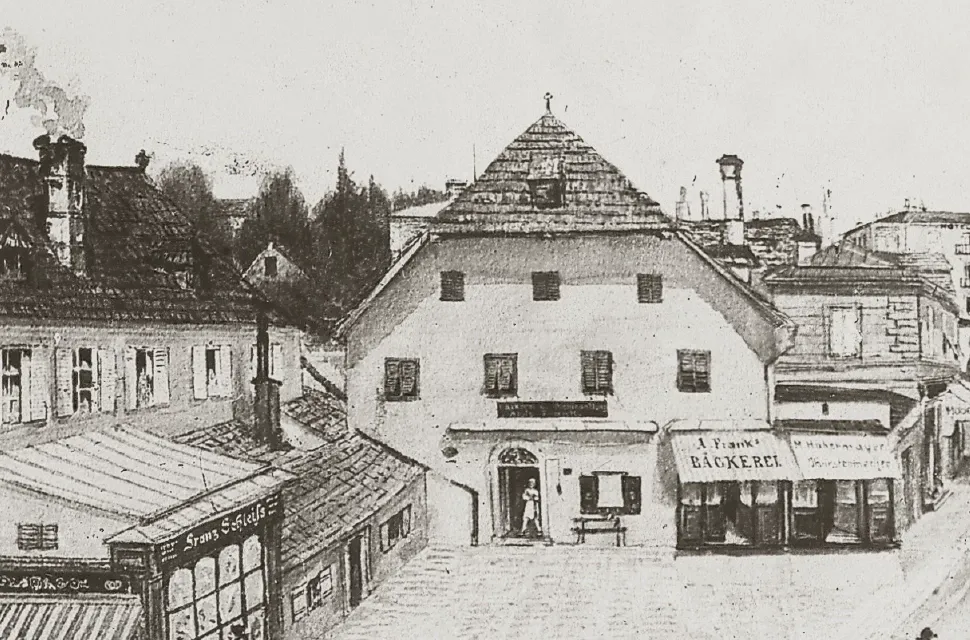
When Gustav Klimt, Gustav Mahler, and Franz Lehár followed Emperor Franz Josef and Empress Elisabeth to the Salzkammergut each summer, they brought an artistic energy the Schleiss family welcomed and nurtured.
“We attach great importance to tradition and quality. This is reflected in everything we do – from our in-house production of colours and glazes to the careful training of our painters.”
In 1909, the family opened the Künstlerische Werkstätte Franz und Emilie Schleiss (the Franz and Emilie Schleiss Artistic Workshop), marking the beginning of Gmundner’s enduring love of art and craft. By 1913, the manufactory had merged with Wiener Keramik, attracting gifted ceramic artists who turned Gmunden into a summer colony of makers.
The tradition passed through hands and generations. In 1968, Johannes Prince Hohenberg, a direct descendant of the Austrian imperial family, took over the manufactory and grew it into Austria’s leading tableware maker. Under his stewardship, Gmundner Keramik was awarded Austria’s national coat of arms, an honor given only to companies of exceptional economic and cultural significance.
Since 2018, the manufactory has been in the hands of Salzburg entrepreneur Markus Friesacher, who took over with 130 employees, the factory showroom and visitor center, and brand stores across Austria. It remains firmly in Austrian hands. The clay still comes from the same source. The flames are still painted by hand. And the craft is still taught the old way: through years of patient apprenticeship.
Craft and materials
From Westerwald clay to UNESCO-protected flaming, made entirely in Gmunden
Gmundner Keramik begins with purified earth: a natural blend of feldspar, quartz, and kaolin sourced from the Westerwald region of Germany. This fine, white clay arrives in powder form and is mixed with water in the manufactory to create either liquid slip for casting or solid clay for turning.
“Each individual piece passes through around sixty hands during production – from the initial moulding to the final finishing. The entire process takes place here in Gmunden.”
Every mold is developed in-house. In the foundry, liquid slip is poured into plaster molds that draw out the moisture, forming clay walls along the mold’s interior. A water jug rests in its mold for an hour before the excess slip is tipped out. Plates, cups, and bowls are turned on a wheel. A rod of clay is sliced, then pressed and shaped into round forms. Angular pieces, like star-shaped bowls, are hand-pressed in molds.
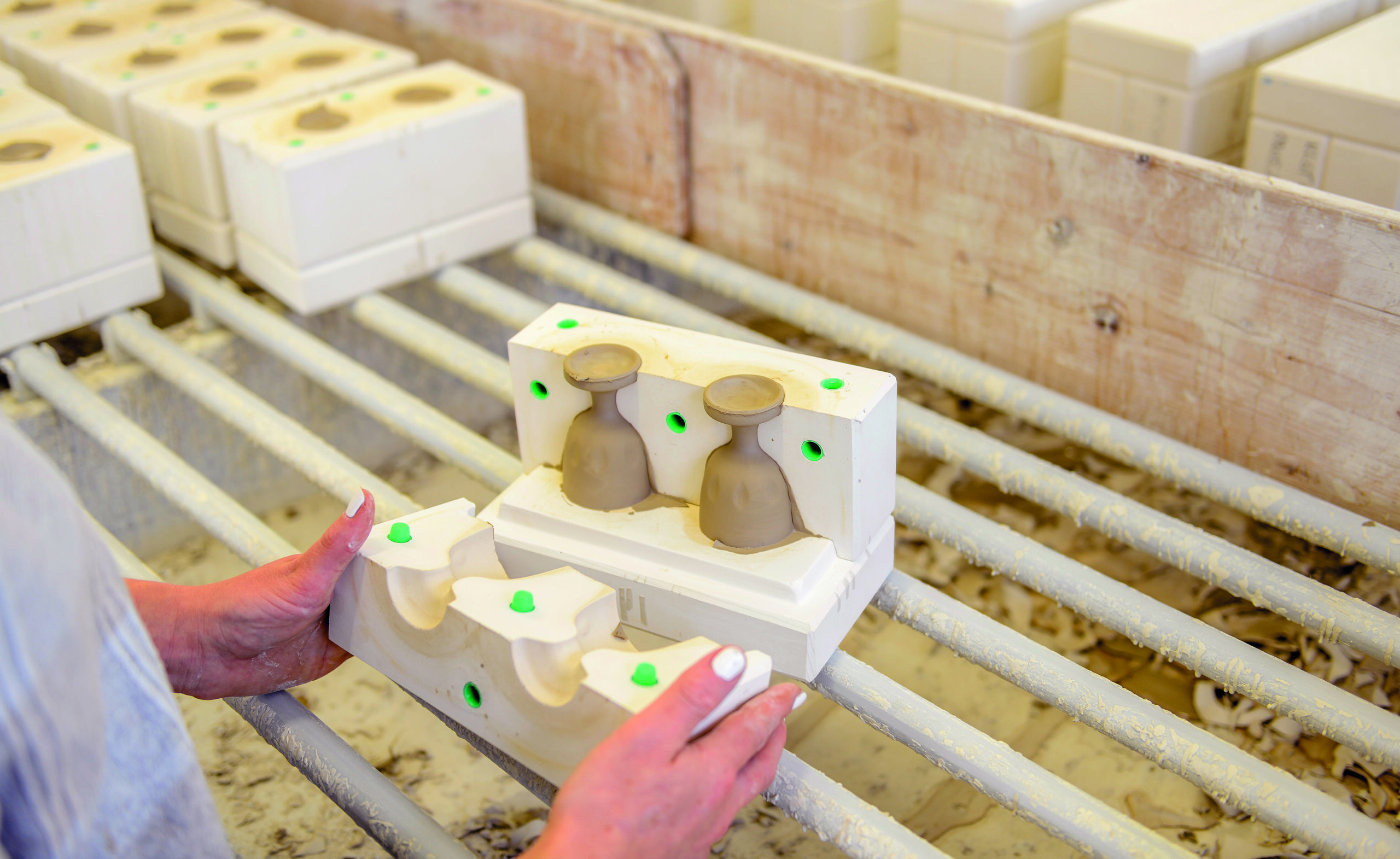
Then comes the finishing. Each piece is cleaned, deburred, and sponged by hand. Every handle, on every jug, cup, and bowl, is added by hand in a process called garnishing. There are no shortcuts.
Gmundner ceramic is glazed with a special white glaze, not transparent like porcelain, but opaque and radiant. This gives each piece its characteristic deep luster. The glaze is applied in two ways: dip glazing, where pieces are dunked into vats using tongs, or spray glazing, where they’re turned on a rotating disc while a fine spray gun coats them evenly.
“The typical Gmundner green is the result of an elaborate and secret recipe. When the paint is applied, it appears grey. It is only after firing that the vibrant color can be seen.”
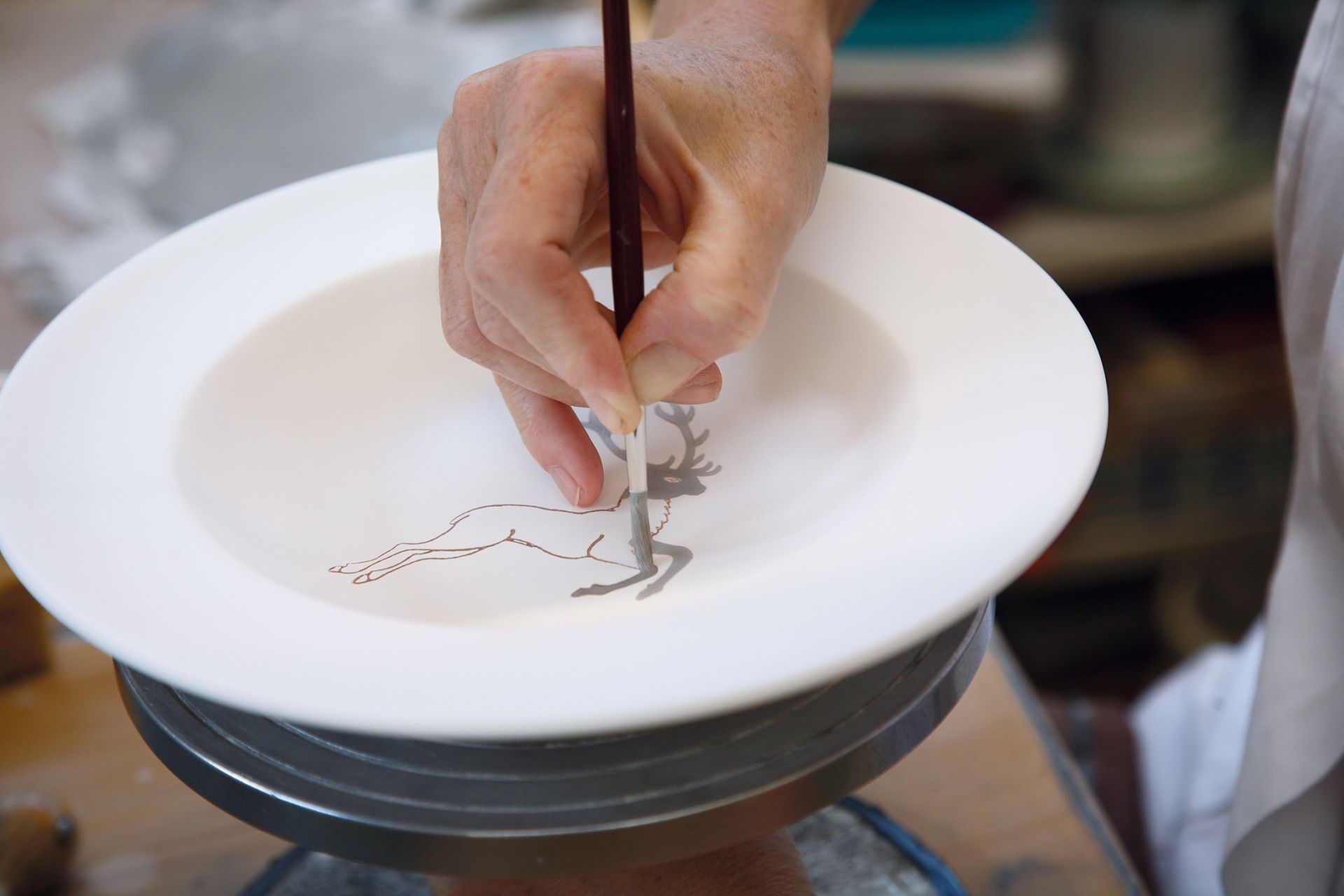
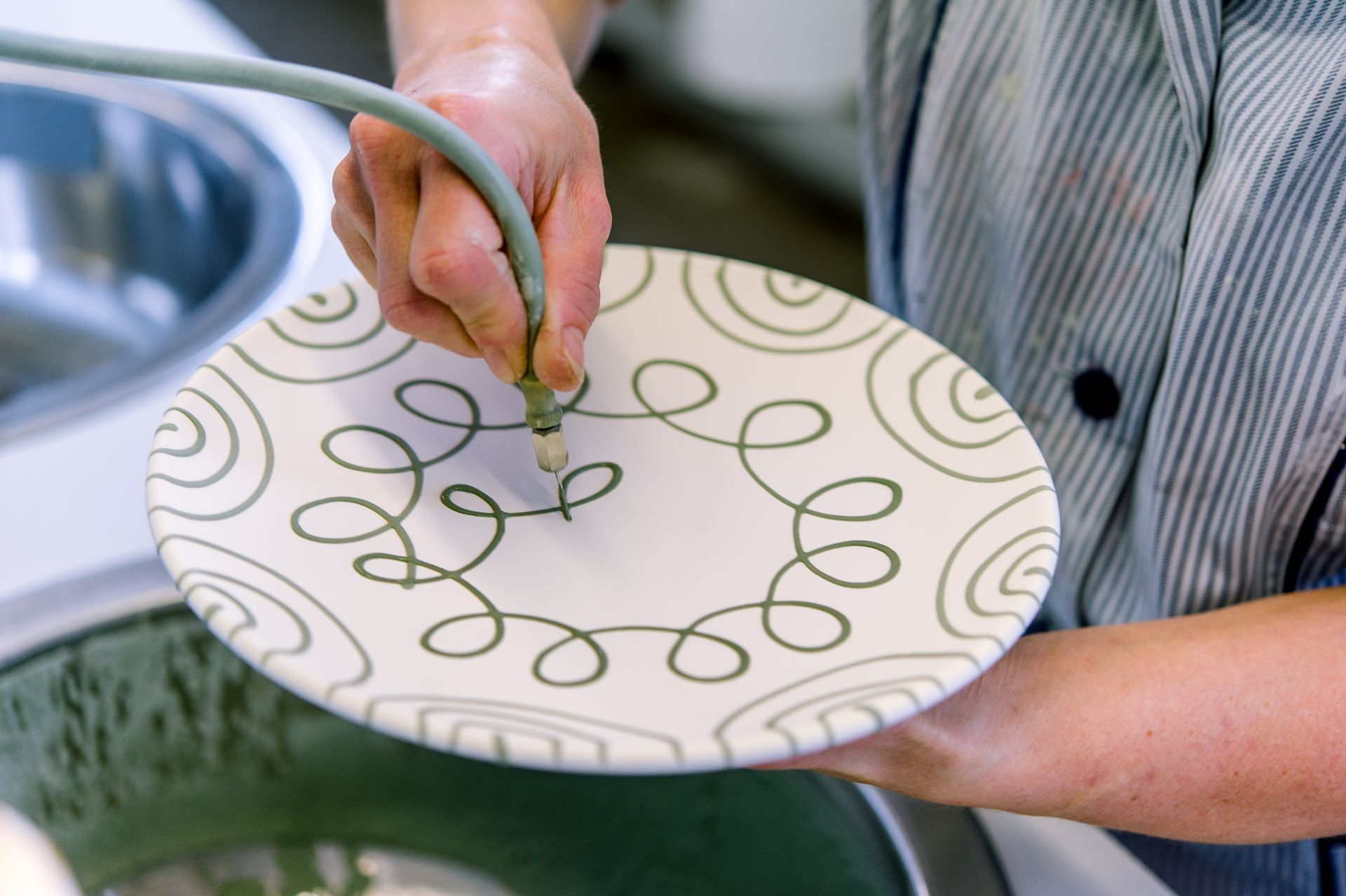
And then: the flames. In 2021, the technique of ceramic flaming was declared a UNESCO Intangible Cultural Heritage. It takes two years to learn. Painters use a spraying technique to apply loops, strokes, and arches in precise patterns. Each item in the range has a specific number of marks that must be honored. The green appears soft and muted before firing. Only heat reveals its true vibrancy.
Design classics (deer, scattered flowers, the Herzerl heart motif) are painted by hand with brushes. Every painted piece is a small act of devotion.
The ceramics are fired twice, each firing lasting sixteen hours at around 1050 degrees.. The first firing, called the “raw firing,” sets the clay. The second, the “glost firing,” fuses the glaze and decoration. Between firings, each piece undergoes a sound test: a gentle tap that reveals any hidden flaws. After the second firing, every item is scanned and scrutinized. Only flawless pieces move forward.
Timeless design
Patterns born in the 1600s, painted fresh each day
Gmundner Keramik doesn’t chase trends. The green flamed pattern dates back to 1600, when the first white and blue ceramics appeared around Gmunden. Over centuries, the technique evolved into the recognizable loops and waves that define the brand today.
The design is deceptively simple: white glaze, green strokes, clean forms. But simplicity is the result of mastery, not ease. Each stroke requires control. Each pattern requires memory. And each piece requires the kind of attention that only comes from years of practice.
“These are simple and elegant pieces. We follow traditional techniques because good design doesn’t need reinvention.”
Gmundner’s shapes are generous and strong, made for daily use, not display. Bowls hold warmth. Jugs pour cleanly. Plates stack without tipping. These are forms refined over centuries of use, shaped by the needs of real tables and real hands.
The colors remain rooted in tradition, though they’ve expanded beyond the original green flames. Wintertime brings snow crystal and winter berry motifs. Spring welcomes scattered flowers. But at the heart of every collection is that unmistakable green: bold, honest, alive.
This is ceramic that refuses to be precious. It’s made to be used, passed down, and used again. Built for generations, not seasons.

Legacy
Carrying an Austrian Cultural Treasure Into the Future
Gmundner Keramik’s legacy rests on something simple: a belief that traditions worth keeping must be lived, not merely remembered. For owner Markus Friesacher, preserving the manufactory is both a cultural duty and a personal calling. He grew up visiting these workshops, watching the flames painted by hand, and today he sees himself as a steward, someone entrusted to protect what five centuries of makers built.
His vision is to grow internationally and at the same time preserve their roots and traditions. Gmundner remains firmly in Austrian hands, using the same clay sources, the same hand techniques, and the same patient training that shaped generations of painters and potters. At the same time, the manufactory is opening itself to new possibilities: artist collaborations, international exhibitions, and the Academy of Ceramics Gmunden, created to ensure the craft is passed on to future makers.


Made to Keep
We handpick our makers and products to be sure they will last a lifetime.

Made in Europe
All products are manufactured in Europe, if not exclusively at the maker’s location.

We stay with you
You will receive maintenance advice, and can access our repair and resell services.

Truly yours
A lot of our handmade products are made to order – just for you.
The Keepers.
Good things worth keeping.
We believe in things made to last: pieces crafted with care, rooted in centuries-old traditions, and designed to outlive trends. Buy to keep. And pass your keepers down the generations with stories to tell.
Follow us: