

Richard Sellmer Verlag
Stuttgart, Germany · Est. 1945


In post-war Stuttgart, Richard Sellmer pictured Christmas at its simplest: lit windows, families gathered indoors, snow on the rooftops. His first calendar, made by hand in his living room in 1945, is back in print today, and his family’s calendars have since decorated the White House and been made for Buckingham Palace. Behind every door is a picture, not a chocolate.
Our Richard Sellmer Verlag favourites
-

 Quick ShipAdvent Calendar “Christmas Eve in the Village”Made in Germany by Richard Sellmer Verlag5,95 €
-

 Quick ShipAdvent Calendar “Snowball Fight in Front of the House”Made in Germany by Richard Sellmer Verlag5,95 €
-

 Advent Calendar “The Little Town”Made in Germany by Richard Sellmer Verlag9,95 €
-

 Quick ShipPanorama Advent Calendar “Little Village in Winter”Made in Germany by Richard Sellmer Verlag9,95 €
-

 Quick ShipPop-up Advent Calendar “By the City Wall”Made in Germany by Richard Sellmer Verlag8,95 €
-

 Quick ShipStanding Advent Calendar “Little Town in the Moonlight”Made in Germany by Richard Sellmer Verlag13,95 €
Origins and people
The Calendar That Brought Christmas Back to Post-War Stuttgart
During the war, Advent calendars disappeared from German homes: paper was short and printing picture calendars was banned. In 1945 the American occupation authorities in Stuttgart granted Richard Sellmer a printing permit, and his calendar became the first to appear after the war. Much of that first Advent season had already passed, yet it sold so well that he expanded the range year after year.
Through international trade fairs, Sellmer took his calendars to America, where Advent calendars were almost unknown. They caught on quickly, and the company came to be called “The Home of Advent Calendar”. Presidents Eisenhower and Nixon were photographed with their families holding Sellmer calendars as part of a charity campaign. Decades later, Bill Clinton sent a handwritten thank-you card for a reprint of a 1950s calendar showing the White House. At home, Richard used the proceeds from his “Alt Stuttgart” motif to restore the bombed windows of Stuttgart’s Collegiate Church.
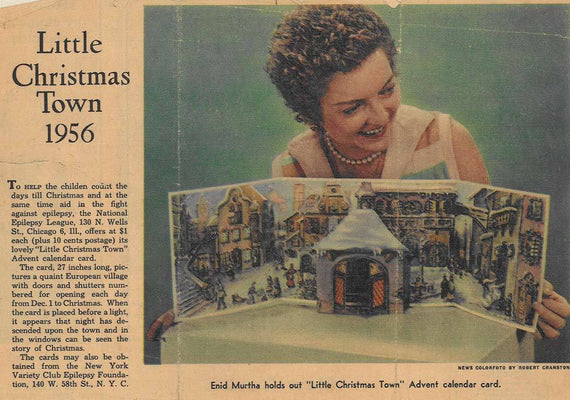
Richard died in 1969. His son Tim modernised production so it could keep up with growing demand. Since Tim’s death in 2008, his sons Frank and Oliver have run the business.
“It is such a beautiful product, the enthusiasm for it has been inherited over the generations.”
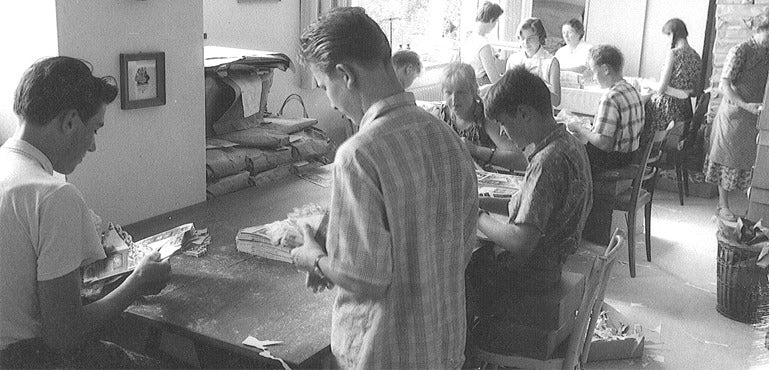
Today Sellmer is still a family business of nine people in Stuttgart. Frank is the publisher, Oliver the managing partner, and Annette runs marketing and press, with the fourth generation already helping out. Around five freelance illustrators design the motifs. Together they send millions of calendars a year to shops in more than 25 countries.
Craft and materials
A Glitter Machine That Has Run Almost Daily for 50 Years
Every motif begins with one of Sellmer’s freelance illustrators. The scenes are then printed and the doors punched out. The pictures behind the doors are printed on a translucent backing, so when the calendar stands on a window sill or in front of a lamp, each opened door glows. The panoramic calendars stand up on their own, with a punched-out outline and a backdrop slotted in behind, and some have doors in the backdrop too.
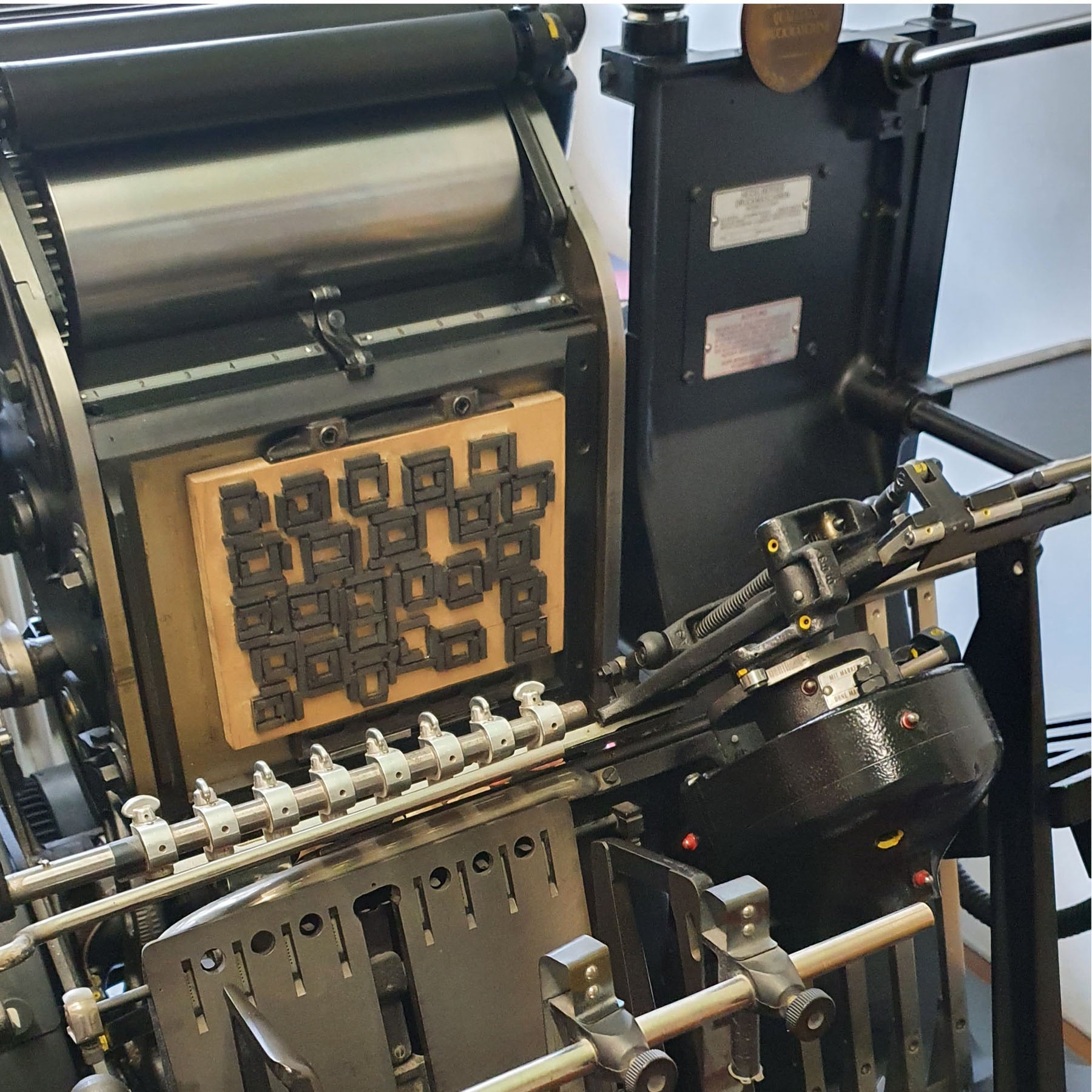
Richard once cut every door by hand. As demand grew, his son Tim moved production to machines, but kept every step under the family’s own roof in Stuttgart, so they have full control over the quality of each calendar. First the front and back are glued together, up to 4,300 calendars an hour. Then comes the silver mica, around 3,000 calendars an hour. No one at that time was selling a glitter machine, so Tim develop one himself, and it has run almost every day for more than 50 years. It gives the fir branches, candles and snowflakes the shimmer of old Victorian scrap pictures.
The work takes all year: new designs start in September, printing begins straight after Christmas, and the first shipments go overseas in March.
Timeless design
Motifs From the Post-War Years, Still in Print
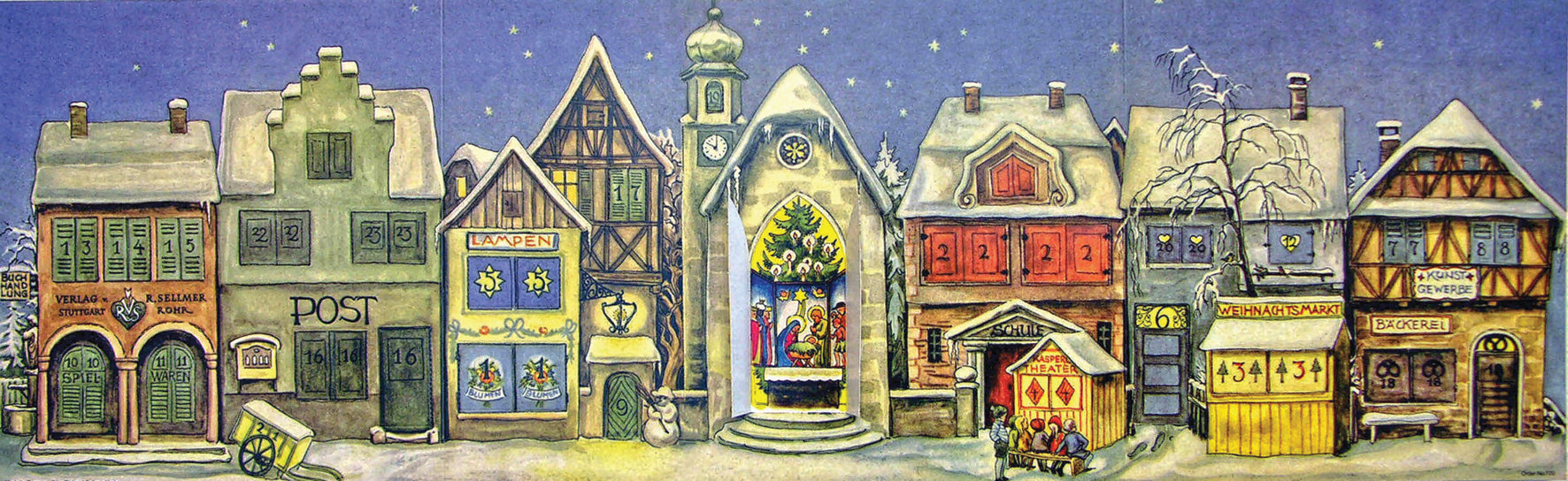
Sellmer’s first calendar, “The Little Town”, was made by Richard by hand, alone, in his living room on Schmellbachstraße, across the street from today’s company building. It shows a long row of houses in the snow. Behind each window is a new scene, and the town comes more to life with every door you open. Since 2005 it has been back in print in its original 22 × 70 cm format, to stand on a sideboard or hang on a wall or window.
“The very first Advent calendar printed after the Second World War. A symbol of hope, peace and the return of Christmas anticipation.”
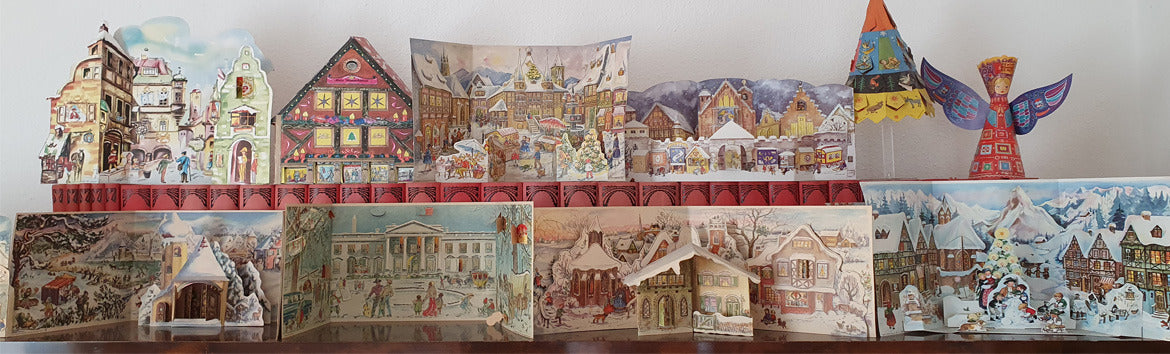
In a country rebuilding after the war, Richard chose Christmas at its simplest: a town in the snow, warm rooms, families together. That’s why his early designs still feel right 80 years later, and why reprints from the archive are now among Sellmer’s most popular calendars. More than 480 motifs have been published since 1945. About 130 are in the current range, around 15 new ones are added each year, and some have never gone out of print since the 1950s.
Every design follows the same house rule:
“What is depicted behind the doors must match the motif of the calendar front page.”
Open a window in the snowy town and you see the family inside that house. On Christian motifs, the doors tell the Christmas story day by day, with the matching Bible verse printed inside each door.
Legacy
Eighty Years of Christmas Anticipation, Still Made in Stuttgart
A Sellmer calendar gives children something to look forward to each morning: not a sweet, but a picture and the curiosity of what comes next. Once December is over, close the doors and keep it for next year.
The scenes are of family rooms, lit windows and villages in the snow, a reminder that Christmas is about the people around the table more than the presents under the tree.
The company has stayed in the family, with four generations working together across the street from the living room where the first calendar was made. Choosing a Sellmer calendar keeps that small workshop and its 80-year-old tradition going.

Made to Keep
We handpick our makers and products to be sure they will last a lifetime.

Made in Europe
All products are manufactured in Europe, if not exclusively at the maker’s location.

We stay with you
You will receive maintenance advice, and can access our repair and resell services.

Truly yours
A lot of our handmade products are made to order – just for you.
The Keepers.
Good things worth keeping.
We believe in things made to last: pieces crafted with care, rooted in centuries-old traditions, and designed to outlive trends. Buy to keep. And pass your keepers down the generations with stories to tell.
Follow us: